
The C_ADBTP certification is designed for professionals who want to demonstrate practical administration skills across SAP Business Technology Platform (SAP BTP). Unlike traditional certification exams that primarily test theoretical knowledge, the current C_ADBTP assessment emphasizes practical, system-based skills. Candidates should therefore prepare by understanding the SAP BTP environment and practicing the administrative tasks they may need to perform.
SAP BTP provides a broad technology foundation for application development, integration, data management, analytics, automation, and artificial intelligence. Administrators play an important role in maintaining these environments, managing access, configuring services, supporting connectivity, monitoring resources, and ensuring that platform resources are used effectively.
The current C_ADBTP format is described by preparation resources as a System-Based Assessment, meaning candidates should focus heavily on applying their knowledge rather than simply memorizing multiple-choice answers.
What Is the C_ADBTP Certification?
The SAP Certified Associate – SAP BTP Administrator certification validates knowledge and practical skills related to administering SAP Business Technology Platform environments. It is particularly relevant for administrators, consultants, developers, and technical professionals who work with SAP BTP landscapes.
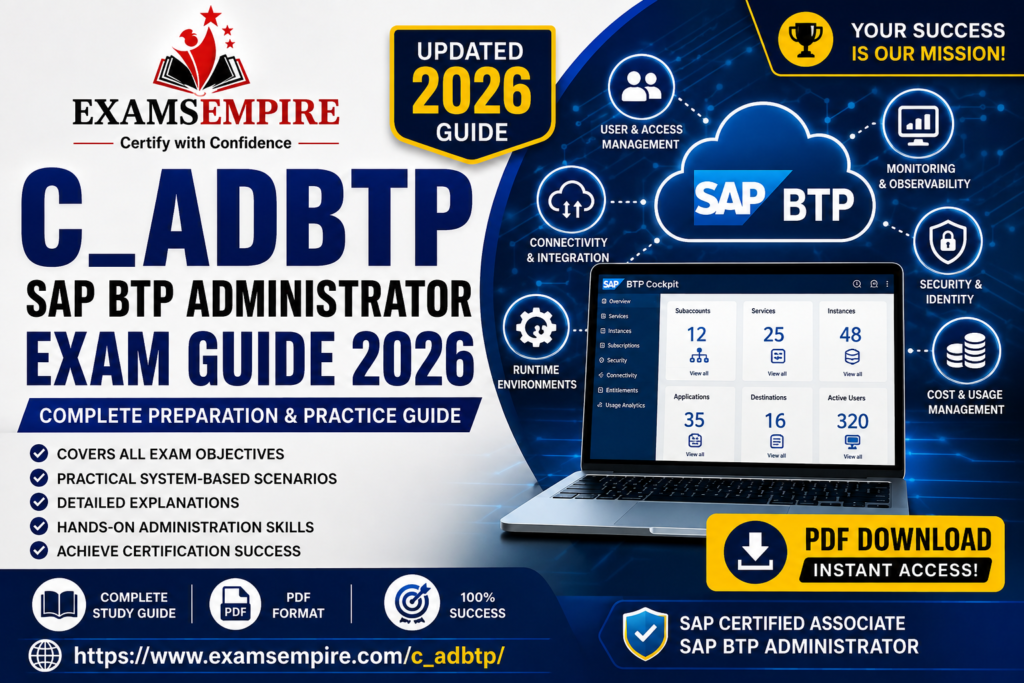
The certification covers important administration responsibilities such as account management, runtime environments, identity and access management, connectivity, configuration, monitoring, availability, disaster recovery, DevOps enablement, and cost management.
Because SAP BTP consists of multiple services and runtime environments, administrators need to understand how these components interact. Successful preparation should therefore combine conceptual study with hands-on experience.
Understanding SAP Business Technology Platform
SAP BTP is a cloud platform that allows organizations to develop, integrate, extend, and operate business applications. It provides services that support application development, data and analytics, integration, automation, and intelligent technologies.
From an administrator’s perspective, understanding the platform’s organizational structure is essential. SAP BTP environments commonly involve a global account, directories, subaccounts, entitlements, service assignments, and runtime environments.
An administrator may need to determine where a service should be enabled, how access should be assigned, and how resources should be organized across different environments.
This makes the account structure one of the most important areas to understand when preparing for C_ADBTP.
SAP BTP Account Structure and Governance
A strong understanding of SAP BTP account management provides the foundation for effective platform administration.
Administrators should understand how global accounts and subaccounts are organized and how entitlements and quotas are managed. They should also understand how services become available to individual subaccounts and how administrative responsibilities can be separated.
Governance is particularly important in enterprise environments because organizations may have multiple teams, applications, regions, and development stages.
When preparing for C_ADBTP, candidates should be comfortable with scenarios involving:
- Global account organization
- Directories and subaccounts
- Entitlements and quotas
- Service plans
- Resource assignment
- Administrative roles
- Environment separation
- Governance and access boundaries
The goal is not simply to memorize definitions. Candidates should understand why a particular account structure is appropriate for a given business scenario.
Runtime Environment Administration
SAP BTP supports different runtime environments, and administrators should understand their purposes and administrative requirements.
Preparation should include the major runtime concepts associated with SAP BTP, including Cloud Foundry, Kyma, and ABAP environments. These environments have different characteristics and administrative considerations.
For example, Cloud Foundry is widely used for cloud-native application deployment, while Kyma provides a Kubernetes-based environment for cloud-native and extension scenarios. The ABAP environment supports ABAP-based application development and extensions in the cloud.
A C_ADBTP candidate should be able to recognize which runtime is appropriate for a particular requirement and understand the basic administrative processes associated with each environment.
Identity and Access Management
Security is another major component of SAP BTP administration.
Administrators need to understand users, groups, roles, role collections, authorizations, and identity providers. SAP Cloud Identity Services can play an important role in managing identities and authentication across SAP landscapes.
When studying identity and access management, focus on practical questions such as:
- Who should have access?
- What permissions are required?
- Which role collection should be assigned?
- How can administrative privileges be restricted?
- How should identities be managed across environments?
- How can access be separated between development and production?
The principle of least privilege is especially important. Users should receive the permissions required to perform their responsibilities without unnecessary administrative access.
SAP BTP Connectivity
Modern enterprise applications rarely operate in isolation. SAP BTP applications frequently need to communicate with on-premises systems, cloud services, APIs, and external applications.
Therefore, connectivity is an important part of C_ADBTP preparation.
Candidates should understand destinations, connectivity services, and SAP Cloud Connector and how they can be used to establish secure communication between systems.
Cloud Connector is particularly important in scenarios where SAP BTP applications need controlled access to resources located in an organization’s on-premises network.
Instead of simply remembering terminology, candidates should understand the purpose of each component and recognize the correct configuration approach for different connectivity scenarios.
Configuration Tools and Automation
SAP BTP administrators may use several tools and approaches to configure and manage platform resources.
Preparation should include concepts involving the SAP BTP cockpit, command-line interfaces, boosters, Automation Pilot, and infrastructure-as-code approaches such as Terraform.
Automation can reduce repetitive administrative work and improve consistency across environments.
For example, instead of manually repeating the same configuration across multiple environments, an administrator may use automation to standardize deployments and configurations.
Candidates should understand when automation is useful and what administrative problem a particular tool is intended to solve.
Monitoring and Observability
A production SAP BTP environment needs continuous monitoring.
Administrators should be able to identify unusual behavior, investigate failures, monitor application and platform resources, and understand the information available through observability tools.
Good monitoring practices can help organizations detect problems before they become major incidents.
When preparing for C_ADBTP, study concepts related to:
- Application monitoring
- Platform monitoring
- Logs
- Metrics
- Alerts
- Resource consumption
- Error investigation
- Operational visibility
Practical troubleshooting scenarios are especially useful because they require candidates to analyze information rather than simply recall a definition.
High Availability and Disaster Recovery
Business-critical applications require appropriate availability and recovery strategies.
Administrators should understand the concepts behind high availability and disaster recovery and how they contribute to business continuity. These areas are included among the C_ADBTP preparation domains identified by current exam-preparation resources.
High availability focuses on keeping systems operational despite certain failures, while disaster recovery focuses on restoring services after a major disruption.
Candidates should understand the difference between these concepts and recognize suitable approaches for different business requirements.
DevOps Enablement
SAP BTP administration also intersects with development and deployment processes.
DevOps practices can help development and operations teams collaborate more efficiently while improving deployment consistency and reducing manual work.
For C_ADBTP preparation, candidates should understand how platform administration supports application lifecycle management and automated deployment processes.
Topics worth reviewing include:
- Application deployment
- Environment management
- Automation
- Configuration consistency
- Development-to-production workflows
- Deployment support
- Infrastructure as code
Understanding the relationship between development and administration can make scenario-based tasks easier to solve.
Cost and Usage Management
Cloud platforms require effective cost control.
SAP BTP administrators should understand how resources are consumed and how organizations can monitor and manage usage.
Entitlements, quotas, service plans, and consumption are all important concepts when managing cloud resources. Administrators need to ensure that teams have sufficient resources while avoiding unnecessary consumption.
This type of reasoning is more useful than memorizing isolated terminology.
For more informatin visit us
https://www.examsempire.com/c_adbtp
Why Hands-On Practice Matters
The system-based nature of the current C_ADBTP assessment makes hands-on practice particularly important. Current preparation resources describe the exam as testing the candidate’s ability to perform administrative tasks in a practical environment rather than relying exclusively on traditional multiple-choice recall.
Candidates should therefore spend time working inside SAP BTP environments whenever possible.
Practical exercises can include creating and organizing subaccounts, reviewing entitlements, configuring services, managing roles, working with destinations, investigating platform information, and practicing administrative workflows.
The more familiar candidates become with the platform interface and administrative processes, the easier it can be to approach practical assessment tasks.
How to Build an Effective C_ADBTP Study Plan
A structured study plan can make preparation much more efficient.
Step 1: Review the Official Objectives
Begin by identifying the skills and topics covered by the current C_ADBTP certification. Do not rely exclusively on older study material because SAP certification formats and objectives can change.
Step 2: Learn the Platform Fundamentals
Before moving into advanced administration, understand the SAP BTP account model, subaccounts, services, entitlements, and runtime environments.
Step 3: Practice Administration Tasks
Move from theory to practical exercises. Try performing common administration operations instead of simply reading about them.
Step 4: Study Security and Connectivity
Spend dedicated time on identity management, role collections, identity providers, destinations, Cloud Connector, and secure connectivity.
Step 5: Practice Troubleshooting
Work through scenarios involving failed deployments, unavailable services, access problems, connectivity issues, or resource limitations.
Step 6: Review Automation
Understand how the cockpit, CLI, boosters, automation tools, and infrastructure-as-code approaches can simplify administration.
Step 7: Test Your Knowledge
Use original practice questions and realistic scenarios to identify weak areas. Avoid relying on leaked or memorized exam content; the goal should be to develop the skills required to perform the tasks successfully.
C_ADBTP Practice Questions
Practice questions are useful because they help candidates evaluate their understanding before exam day.
However, the best practice material should focus on scenarios and practical decision-making rather than simply reproducing supposed real exam questions.
For example, a useful practice scenario might describe an organization with multiple subaccounts and ask the candidate to determine how services, permissions, and entitlements should be organized.
Another scenario might involve an application that needs secure access to an on-premises resource. The candidate would then need to determine which connectivity components should be configured.
These scenarios encourage candidates to understand the platform instead of memorizing answers.
Common C_ADBTP Preparation Mistakes
One of the biggest mistakes candidates make is treating a practical certification like a traditional theory exam.
Reading documentation is important, but reading alone may not provide enough preparation for system-based tasks.
Another common mistake is focusing on only one part of SAP BTP. A candidate might understand Cloud Foundry well but have limited knowledge of identity management, connectivity, or account governance.
A better approach is to study the platform as an integrated environment.
Candidates should also avoid depending entirely on outdated preparation materials. Current resources indicate that the C_ADBTP format has evolved toward a system-based assessment, so preparation should reflect the current format.
Final Exam Preparation Tips
Before taking the C_ADBTP assessment, review the major administration areas and make sure you can explain the purpose of the important platform components.
Focus especially on:
- SAP BTP account structure
- Entitlements and quotas
- Runtime environments
- Identity and access management
- Cloud Identity Services
- Destinations
- Cloud Connector
- Configuration and automation
- Monitoring and observability
- High availability
- Disaster recovery
- DevOps enablement
- Cost and consumption management
The C_ADBTP SAP BTP Administrator certification is a valuable credential for professionals working with SAP Business Technology Platform administration. Its practical focus means that candidates should develop both theoretical knowledge and hands-on platform skills.
A successful preparation strategy begins with understanding the SAP BTP account model and continues through runtime administration, identity management, connectivity, automation, monitoring, availability, DevOps, and cost management. Current preparation sources describe these areas as important components of the C_ADBTP skill set.
Candidates who combine official learning resources with hands-on practice, realistic scenarios, and systematic revision can approach the assessment with greater confidence. Rather than attempting to memorize answers, focus on understanding how SAP BTP works and how an administrator should respond to real operational requirements.
With consistent preparation and practical experience, the C_ADBTP exam becomes much more manageable and can provide a strong foundation for professionals pursuing careers in SAP cloud administration and SAP Business Technology Platform.