

By the Foreign Affairs Desk | March 25, 2026
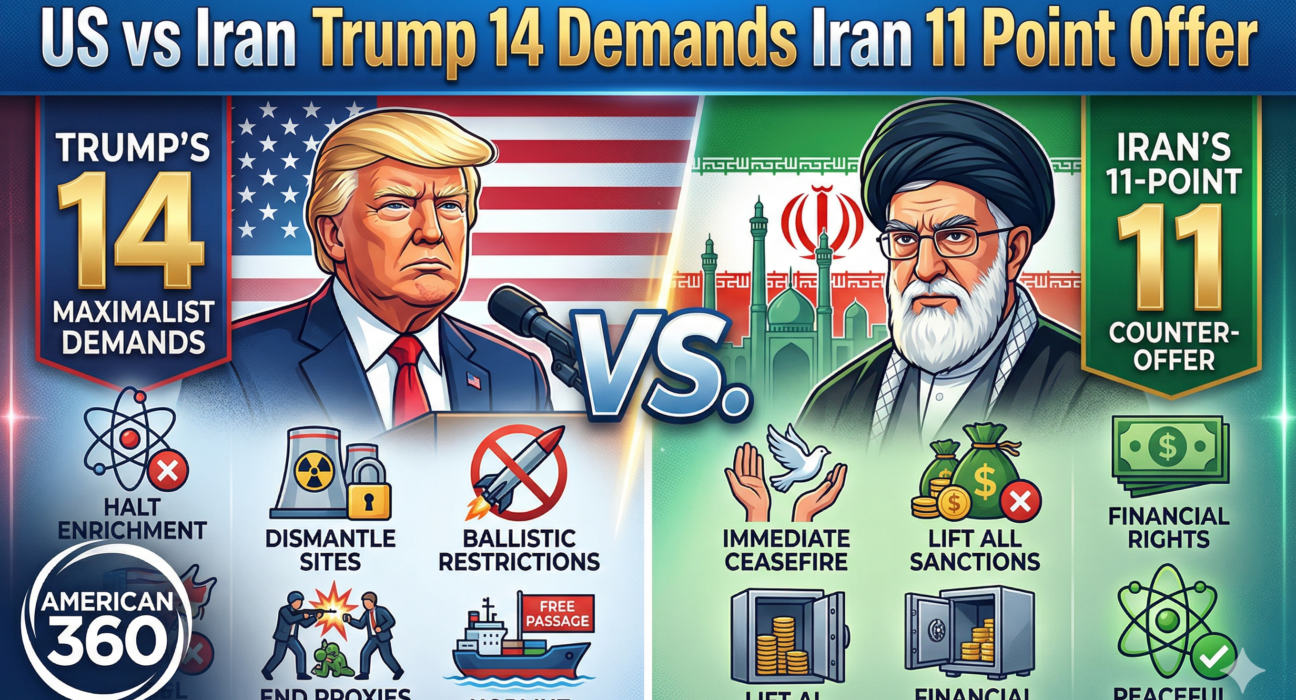
Executive Summary: As high-stakes negotiations between the United States and Iran unfold during President Donald Trump’s second term, a stark diplomatic divide has emerged. Washington is driving a hardline, 14-point maximalist agenda aimed at dismantling Tehran’s nuclear and regional capabilities. In stark contrast, Tehran has tabled an 11-point counter-offer heavily focused on economic survival, sweeping sanctions relief, and ironclad security guarantees.
Here is an exclusive, in-depth look at the roadmaps both nations are bringing to the negotiating table.
The Washington Playbook: Trump’s 14-Point Ultimatum
In recent public addresses and closed-door diplomatic sessions, the Trump administration has made it clear that any new nuclear agreement must be preceded by profound concessions from Tehran. Washington’s 14 demands are sweeping, targeting not just Iran’s nuclear ambitions, but its broader military and geopolitical footprint in the Middle East.
1. The Nuclear Rollback
- Complete Halt to Uranium Enrichment: Moving toward a strict “zero enrichment” standard, Washington demands an absolute freeze on all enrichment activities.
- Dismantling Key Facilities: The U.S. is calling for the shuttering or disabling of major nuclear infrastructure, specifically naming Fordow, Natanz, and Isfahan.
- Intrusive IAEA Inspections: The administration insists on unlimited, unannounced, and immediate access for the International Atomic Energy Agency (IAEA) to all declared and suspected sites.
- Full Declaration of Sites: Iran must officially declare every nuclear-related facility, with severe penalties outlined for any concealed locations.
- Written Renunciation of Nuclear Weapons: Trump’s negotiating team is demanding a formal, binding commitment from Iran’s Supreme Leadership that Tehran will never pursue, acquire, or develop a nuclear arsenal.
2. Curbing Military & Regional Power
- End to the Ballistic Missile Program: The U.S. demands a complete freeze or drastic dismantling of Iran’s long-range missile development.
- Capping Missile Ranges: American diplomats have proposed limiting any remaining missile capabilities to a maximum range of 1,000 kilometers.
- Defunding Regional Proxies: A non-negotiable point for Washington is the cessation of financial, logistical, and military support for groups like Hezbollah, Hamas, the Houthis, and Shia militias operating in Iraq and Syria.
- Halting Attacks on U.S. Forces: As a strict precondition for continued talks, all direct and proxy attacks on American troops, bases, and regional allies must cease immediately.
- Curbing Militia Capabilities: The U.S. expects Iran to severely reduce the offensive capabilities of its internal security apparatus, specifically targeting the Islamic Revolutionary Guard Corps (IRGC).
3. Global Security & Diplomatic Normalization
- Guaranteeing Free Passage: Iran must permanently cease threatening international shipping in the Strait of Hormuz, recognizing it unconditionally as an open international waterway.
- Halting Cyber and Covert Operations: Iran must end all state-sponsored cyberattacks and covert terror-related activities against the U.S. and its global allies.
- A Broader Security Framework: Washington wants the bilateral deal tied to a wider, comprehensive regional security arrangement involving neighboring Gulf states.
- Phased Normalization: Should Iran comply with these extensive demands, the U.S. has signaled an openness to a gradual, heavily monitored restoration of diplomatic and economic relations.
Tehran’s Pushback: Iran’s 11-Point Counter-Offer
Refusing to capitulate to what it views as a one-sided surrender, Iran’s leadership has presented an 11-point package. Tehran’s strategy hinges on preserving its sovereignty, reviving its crippled economy, and ensuring that any concessions are met with immediate, tangible rewards.
1. Security and Sovereignty Guarantees
- Immediate, Lasting Ceasefire: Tehran demands a verifiable end to all military operations and covert strikes against its territory and strategic interests.
- No New Attacks on Iranian Soil: Iran is seeking legally binding, written assurances that the U.S., Israel, and allied forces will halt all airstrikes and ground operations within Iranian borders.
- Territorial Sovereignty: A formal, international guarantee that Iran’s current borders and political sovereignty will remain respected and untouched.
- Compensation for Damages: In a highly contentious demand, Tehran is pushing for financial reparations for material and infrastructure losses sustained during recent conflicts and shadow wars.
2. Economic Revival & Sanctions Relief
- Total Lifting of Existing Sanctions: Iran demands a precise, rapid timetable for the complete eradication of U.S. and international sanctions crippling its economy.
- Restoration of Financial Access: Tehran insists on immediate reintegration into the global banking system (including SWIFT) and the total unfreezing of its foreign assets.
- Unrestricted Energy & Industry Exports: The immediate removal of embargoes targeting Iran’s vital oil and gas exports, as well as its heavy industry and technology sectors.
- End to Blacklisting: Tehran is calling for the removal of terror designations and blacklists currently targeting its top officials, state banks, and the IRGC.
3. Geopolitical Rights & Regional Posture
- Recognition of Peaceful Nuclear Rights: Rejecting the “zero enrichment” standard, Iran insists its nuclear program must be globally recognized as a legitimate civilian energy and research initiative, permitting limited, monitored enrichment.
- Strait of Hormuz Navigation: While calling for the removal of Western military blockades in the Strait, Iran maintains its sovereign right to defend its territorial waters.
- Inclusive Regional Dialogue: Iran demands that the current negotiations evolve to include broader security talks with Gulf neighbors, Israel, and other regional actors to establish a localized balance of power rather than an American-imposed one.
News Analysis: Bridging the Unbridgeable Gulf?
As the ink dries on these competing proposals, diplomatic analysts agree that the two sides remain separated by a massive ideological and strategic gulf.
President Trump’s 14-point list is unapologetically focused on rollback—systematically dismantling the military and nuclear infrastructure Iran has spent decades building. Conversely, Iran’s 11-point agenda is fundamentally about survival and recognition—demanding an end to economic strangulation and foreign military threats before it surrenders any leverage.
A breakthrough remains highly unlikely unless both Washington and Tehran signal a willingness to walk back from these maximalist cliffs. For now, the 14-point U.S. ultimatum and the 11-point Iranian counter-offer serve as the opening bids in what promises to be one of the most grueling diplomatic standoffs of the decade.