

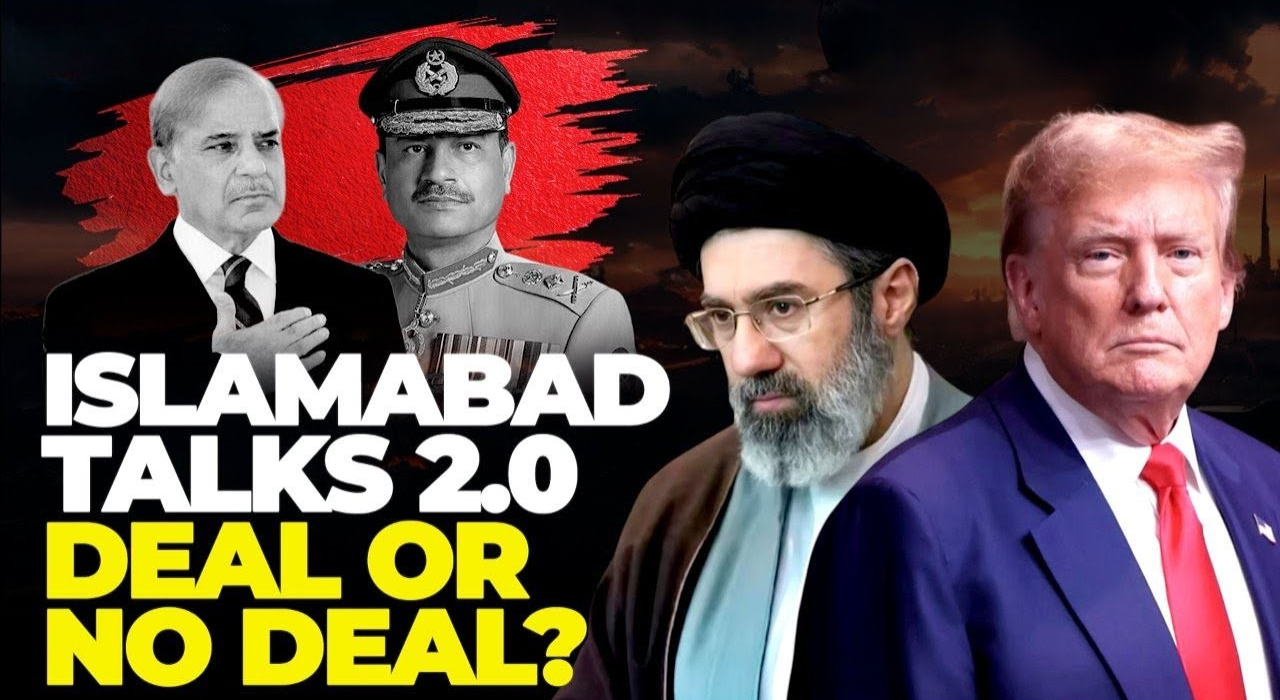
With a ceasefire on the brink of collapse and the Strait of Hormuz under fire, Washington makes one last diplomatic push — but Tehran is not yet at the table
By Staff Correspondent | April 20, 2026
ISLAMABAD / WASHINGTON — The clock is ticking. A two-week ceasefire between the United States and Iran is set to expire on Wednesday, and with it, the last thread of diplomatic calm holding together a volatile and increasingly dangerous standoff. On Sunday, U.S. President Donald Trump announced that American negotiators would once again board a plane for Islamabad — but the critical question haunting every foreign ministry from Washington to Tehran is a simple one: will Iran even show up?
Trump’s Announcement — and the Threat Behind It
In a characteristically blunt post on Truth Social, Trump declared that his representatives would return to the Pakistani capital for a second round of talks with Iranian officials. Trump identified White House Special Envoy Steve Witkoff and his son-in-law Jared Kushner as part of the delegation heading to Islamabad. Later, according to Axios, Vice President JD Vance is also set to lead the U.S. delegation for another round of negotiations, giving the mission its highest-level political weight yet.
But the announcement did not come wrapped in olive branches. Trump simultaneously accused Tehran of a “total violation” of the existing ceasefire, alleging that Iranian forces had fired on vessels attempting to transit the Strait of Hormuz. In his Truth Social post, Trump wrote that Iran had violated the ceasefire and warned: “We’re offering a very fair and reasonable DEAL, and I hope they take it because, if they don’t, the United States is going to knock out every single Power Plant, and every single Bridge, in Iran. NO MORE MR. NICE GUY!”
Diplomacy delivered at gunpoint — this has become the defining feature of Trump’s negotiating posture throughout this crisis.
What Sparked the Latest Crisis
Iran said on Saturday that it had reinstated control of the Strait of Hormuz, reversing course on its earlier decision to reopen the critical waterway, and would keep it closed until the United States completely lifts its naval blockade of Iranian ports. The Strait of Hormuz, through which roughly a fifth of the world’s oil supply flows, has become the central pressure point of the entire conflict.
The maritime confrontation rapidly escalated. The UK Maritime Trade Operations Centre said it had received a report from a tanker that had been approached and then fired on by “two IRGC gunboats” 20 nautical miles northeast of Oman. The captain said there had been no radio warning beforehand, though the tanker and crew were reported safe.
Trump’s response was to call it a “Total Violation” of the ceasefire and immediately announce the new round of talks — framing aggression and negotiation simultaneously, a tactic that has left both allies and adversaries uncertain about Washington’s ultimate intentions.
The First Round: 21 Hours, No Deal
To understand why this second round matters so much, one must look back at what happened in Islamabad last weekend.
The first Islamabad Talks took place on April 11 and 12, 2026, and were aimed at stabilizing the ceasefire and negotiating a potential resolution to the broader conflict. The 300-member U.S. negotiating team was led by Vice President JD Vance, alongside special envoys Steve Witkoff and Jared Kushner, while the 70-member Iranian team was led by parliamentary speaker Mohammad Bagher Ghalibaf and Foreign Minister Abbas Araghchi. Pakistani Prime Minister Shehbaz Sharif, Field Marshal Asim Munir, and Deputy Prime Minister Ishaq Dar led the Pakistani mediating team.
The talks were historic in their scope. Those first face-to-face negotiations ran for 21 hours across Saturday into Sunday before collapsing without an agreement. The failure was not a matter of procedural disagreements or scheduling conflicts — it exposed something far deeper.
The Islamabad negotiations collapsed over three irreconcilable issues: Iran’s uranium enrichment programme, its funding for regional proxy groups including Hezbollah, and the Strait of Hormuz. As one analyst put it bluntly: these were not positions that could be split across a weekend summit.
Iran’s Position: Suspicion, Rejection, and Red Lines
Tehran’s response to Trump’s second-round announcement has been cold — and deeply suspicious.
Iran’s official IRNA news agency reported that Iranian officials would not take part in the talks owing to “Washington’s excessive demands, unrealistic expectations, constant shifts in stance, repeated contradictions, and the ongoing naval blockade, which is considered to be a breach of the ceasefire.”
A senior Iranian official told the Associated Press that Iran was not ready to hold new face-to-face talks with U.S. officials, and that the country would not hand over its enriched uranium to the United States.
Iran’s chief negotiator, Mohammad Bagher Ghalibaf, has been unsparing in his assessment. He acknowledged that “there is still a big distance between us,” while insisting that Iran remained committed to diplomacy in principle. For its part, Iran’s Foreign Ministry has condemned the U.S. naval blockade as “not only a violation of the Pakistani-mediated ceasefire but also both unlawful and criminal.”
According to Axios, Iranian officials are also deeply wary of Washington’s true motives. Iranian officials appear suspicious that Trump’s talk of a deal could be cover for something else altogether — viewing the diplomatic overtures with significant distrust.
Pakistan: The Indispensable Mediator
One of the most significant geopolitical developments to emerge from this crisis is the extraordinary role Pakistan has assumed as a peace broker between two nuclear-armed powers it has no alliance with.
Pakistani Prime Minister Shehbaz Sharif, who has emerged as the primary mediator in the war, said he had “a warm and constructive conversation” with Iranian President Masoud Pezeshkian on Sunday, though he stopped short of confirming Iran had formally agreed to a second round of talks.
Security measures were tightened in Islamabad ahead of the expected talks, with Pakistani authorities restricting movement near the site of last week’s discussions — a sign that despite Tehran’s public rejection, Islamabad has not given up hope of bringing both sides back to the table.
Pakistan’s role is not merely logistical. As a Muslim-majority nation with diplomatic relations in both Washington and Tehran, and without the baggage of direct military involvement, Islamabad offers what few capitals can: trusted neutrality.
The Sticking Points: Nuclear Programme and Strait Control
At the heart of this conflict lie two questions that neither side is willing to yield on easily.
The main sticking points remain Iran’s nuclear programme — particularly its stockpile of enriched uranium — and control over the Strait of Hormuz.
The Iranians had issued a counter-proposal including an end to U.S.-Israeli attacks, security guarantees against future aggression, war reparations, and international recognition of Iranian sovereignty over the Strait of Hormuz — a proposal Washington rejected.
Secretary of State Marco Rubio has urged European countries to quickly decide on reimposing sanctions against Iran, warning that Iran is violating the existing agreement and nearing the capability to develop a nuclear weapon. Rubio also said Iran could have a civilian nuclear energy programme instead of a military atomic weapons programme.
U.S. Senator Bill Cassidy reinforced Washington’s bottom line plainly: the ongoing talks with Iran were to ensure the country would not be able to develop a nuclear weapon.
Trump’s Optimism vs. On-the-Ground Reality
Despite the hardened positions on both sides, Trump himself projected optimism in a brief call with Axios. He said: “I feel fine about it. The concept of the deal is done. I think we have a very good chance to get it completed.”
Whether that confidence is grounded in back-channel progress or is simply characteristic presidential bravado remains unclear. What is clear is the broader strategic logic: the two-week U.S.-Iran ceasefire signed this month is set to expire on Wednesday, leaving negotiators with almost no time to bridge gaps that 21 hours of direct talks failed to close.
The U.S. naval blockade targeting vessels entering or departing Iranian ports is now fully enforced, with American ships actively blocking traffic — a posture Iran considers an act of war, even as Washington frames it as leverage for a deal.
What Happens If Talks Fail?
The consequences of a diplomatic breakdown extend far beyond the Middle East. Global oil markets, already rattled by months of Hormuz disruptions, would face further shock. European energy markets, corporate earnings and supply chains are facing what analysts describe as the most dangerous week since the war began.
Major shipping companies had already responded to earlier disruptions — Maersk, CMA CGM, and Hapag-Lloyd had suspended services through the strait — with profound ripple effects on global trade.
Militarily, a return to open hostilities would mean renewed U.S.-Israeli airstrikes on Iran, which had already pushed the region to the brink of a wider conflagration before the ceasefire was agreed on April 8th.
Analysis: Can This Round Succeed Where the Last One Failed?
The honest answer, based on what is publicly known, is: it is far from certain.
The structural gap between Washington and Tehran has not changed. The U.S. wants Iran to dismantle its nuclear programme and relinquish strategic control over the Strait of Hormuz. Iran wants sovereignty, reparations, and regional recognition. These are not differences of degree — they are differences of fundamental national interest.
What has changed is the urgency. The ceasefire expires Wednesday. Both sides have something to lose from renewed war. Pakistan’s Shehbaz Sharif is working the phones. And Trump — for all his belligerence — is sending his highest-ranking diplomats, including the Vice President himself, back to the table.
That is not nothing. But it may not be enough.