

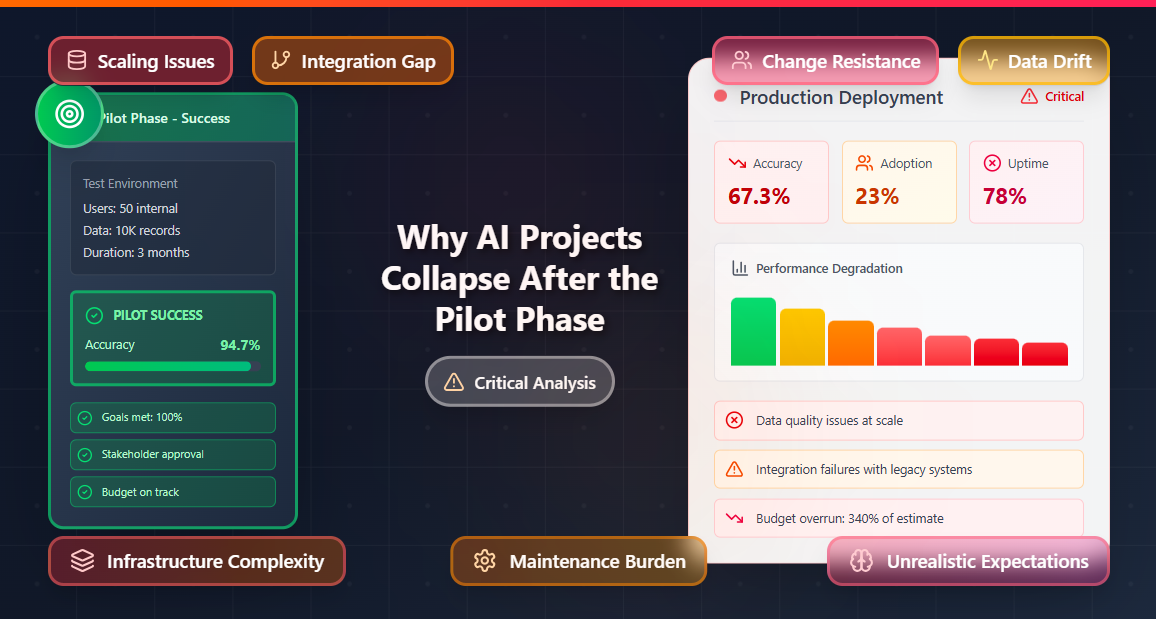
AI pilots often begin with excitement. A small team builds a model. The demo works. The dashboard looks clean. The leadership team sees a few promising results. Someone says, “This could save hundreds of hours.” Another person says, “Let us scale this.”
Then the project quietly slows down.
Weeks pass. The pilot is still “under review.” The business team is unsure how to use it. The technology team is busy with other priorities. Compliance asks new questions. Data quality issues appear. Integration costs increase. The project does not officially fail, but it stops moving.
This is the real story behind many AI projects. They do not collapse loudly. They fade after the pilot phase because the company was ready for a demonstration, not for operational change.
The Pilot Theatre Problem
Many AI pilots are built to impress, not to operate.
A pilot is usually created in a controlled environment. The data is selected carefully. The use case is narrow. The users are cooperative. The technical team is close to the project. Problems are fixed quickly because everyone wants the pilot to succeed.
This creates what many companies do not want to admit: pilot theatre.
The project looks successful because the conditions are artificial. But once it moves toward production, the real business environment is very different.
The system must now handle:
- Live and messy data
- Real users with different skill levels
- Existing software systems
- Security and access rules
- Compliance checks
- Budget approval
- Performance monitoring
- Support and maintenance
A pilot proves that an idea can work. It does not prove that the business is ready to run it every day.
No Clear Scale Criteria
One major reason AI projects collapse is that nobody defines what “ready to scale” means.
The pilot may be called successful because the model reached a certain accuracy level or because users liked the demo. But those are not enough. Scaling needs more practical conditions.
Before moving beyond the pilot, leaders should ask:
- Does the system solve a real business problem?
- Is the output useful inside the existing workflow?
- Can the data be refreshed without manual effort?
- Can users understand and trust the result?
- Is the cost acceptable at full scale?
- Are legal, security, and compliance teams aligned?
- Who owns the system after launch?
If these questions are not answered, the project enters confusion. The technical team thinks the pilot is complete. The business team thinks more work is needed. Leadership wants impact but does not know what is blocking progress.
Without scale criteria, the pilot becomes a nice experiment with no clear next step.
Production Readiness Debt
AI pilots often carry hidden debt. This is not always financial debt. It is operational debt.
During the pilot, teams take shortcuts. They manually clean data. They use temporary scripts. They skip full documentation. They avoid complex edge cases. They build a simple interface because the goal is speed.
This is understandable. But those shortcuts do not disappear. They return later as production readiness debt.
The company then discovers that the pilot needs major work before it can operate safely. The model may need better data pipelines. The system may need stronger security. The workflow may need approval logic. The interface may need user controls. The infrastructure may need to be rebuilt.
At this point, leaders may feel surprised by the extra cost. But the cost was always there. The pilot simply delayed it.
Executive Alignment Breaks After the Demo
AI pilots often have executive excitement but not executive alignment.
There is a difference.
Excitement means leaders like the idea. Alignment means leaders agree on the business priority, budget, timeline, risk level, ownership, and expected return.
Many AI projects get approval because the concept sounds strategic. But after the pilot, different leaders may have different expectations.
The CEO may want business impact.
The CTO may worry about integration.
The CFO may ask for ROI.
The legal team may raise risk concerns.
The business unit may want customization.
The operations team may worry about support.
None of these concerns are wrong. The problem is that they appear too late.
A serious AI pilot should begin with leadership alignment, not end with it.
The Workflow Does Not Match Reality
A pilot can perform well and still fail because it does not fit the real workflow.
This happens more often than companies expect.
For example, an AI system may predict which customer accounts are at risk. But if account managers do not receive that insight inside their CRM, they may ignore it. A document review tool may summarize files quickly. But if legal teams still need to copy the result into another system, the tool adds work instead of reducing it.
This is where working with a reliable software development company in Japan can help businesses connect AI outputs to real workflows, actions, and measurable results.
A useful AI system should answer:
- Who receives the output?
- What decision does it support?
- What happens after the result appears?
- Which system records the next step?
- How does the user give feedback?
If the AI output does not fit naturally into daily work, people stop using it. Not because the model is weak, but because the process is poorly designed.
Data Contracts Are Missing
Another reason AI projects fail after pilots is weak data ownership.
In many companies, data sits across departments. Sales owns one system. Finance owns another. Operations manages separate records. Customer support uses different tags. The AI team needs all of this data, but no one has agreed on responsibility.
This is where companies need data contracts.
A data contract is a clear agreement about what data will be provided, in what format, at what quality level, how often, and by whom.
Without this, the AI system becomes fragile. One department changes a field name. Another stops updating a file. A third introduces a new category. Suddenly, the model output becomes unreliable.
AI does not only need data. It needs dependable data operations.
Compliance and Procurement Arrive Too Late
In many AI pilots, compliance, legal, procurement, and security teams are invited after the demo. That is a mistake.
These teams may ask important questions:
- Where is the data stored?
- Is personal information being processed?
- Who can access the model output?
- Does the vendor meet security requirements?
- Can the system be audited?
- Are there regulatory risks?
- What happens if the model gives a wrong recommendation?
If these questions appear late, the project slows down. Sometimes it stops completely.
This does not mean compliance teams are blocking innovation. It means the project did not include them early enough.
For AI projects, governance should be built into the pilot plan from the beginning.
User Trust Breaks Quietly
AI systems depend on trust.
If users do not understand the result, they will not act on it. If the system makes a few visible mistakes, users may reject it. If the AI feels like extra monitoring or extra work, adoption will fall.
Trust is not created by telling people the system is intelligent. Trust is created through usefulness, clarity, and control.
Users need to know:
- What the AI is doing
- What data it uses
- How confident the output is
- When they should question it
- How they can give feedback
- Who is responsible for final decisions
Many pilots fail because user trust is not treated as a design requirement. The company builds the model but forgets the people who must use it.
The Handover Is Not Planned
An AI pilot is often owned by an innovation team. But production systems need long-term ownership.
After the pilot, someone must manage support, updates, monitoring, retraining, user training, security reviews, and performance reporting.
If this handover is unclear, the project gets stuck.
The innovation team may say, “Our pilot is complete.”
The IT team may say, “We were not involved early enough.”
The business team may say, “We do not know how to manage it.”
Leadership may say, “Why is this not live yet?”
A pilot should not begin unless the company knows who will own the system after success.
No Measurement After Go-Live
Some AI projects do reach production, but still fail because no one measures real impact.
The company tracks model accuracy but not business value. It celebrates deployment but does not measure adoption. It builds dashboards but does not check whether decisions improved.
Real AI success should be measured through business outcomes such as:
- Time saved
- Cost reduced
- Errors avoided
- Revenue improved
- Risk lowered
- Customer experience improved
- Employee productivity increased
Without post-launch measurement, AI becomes a technology expense instead of a performance asset.
Conclusion
AI projects collapse after the pilot phase because the pilot is often treated as the finish line. In reality, it is only the first gate.
The real challenge begins after the demo, when the system must work with live data, real users, business rules, security reviews, compliance needs, existing software, and measurable outcomes.
Companies that want AI to scale must stop asking only, “Can we build this?” They must also ask, “Can we operate this, trust this, measure this, and improve this over time?”
Successful AI requires more than a smart model. It requires production discipline, business ownership, clean data agreements, workflow design, governance, user trust, and clear accountability. Organizations that build with this mindset will have a far better chance of turning pilot success into long-term business value through the right AI software development services.