
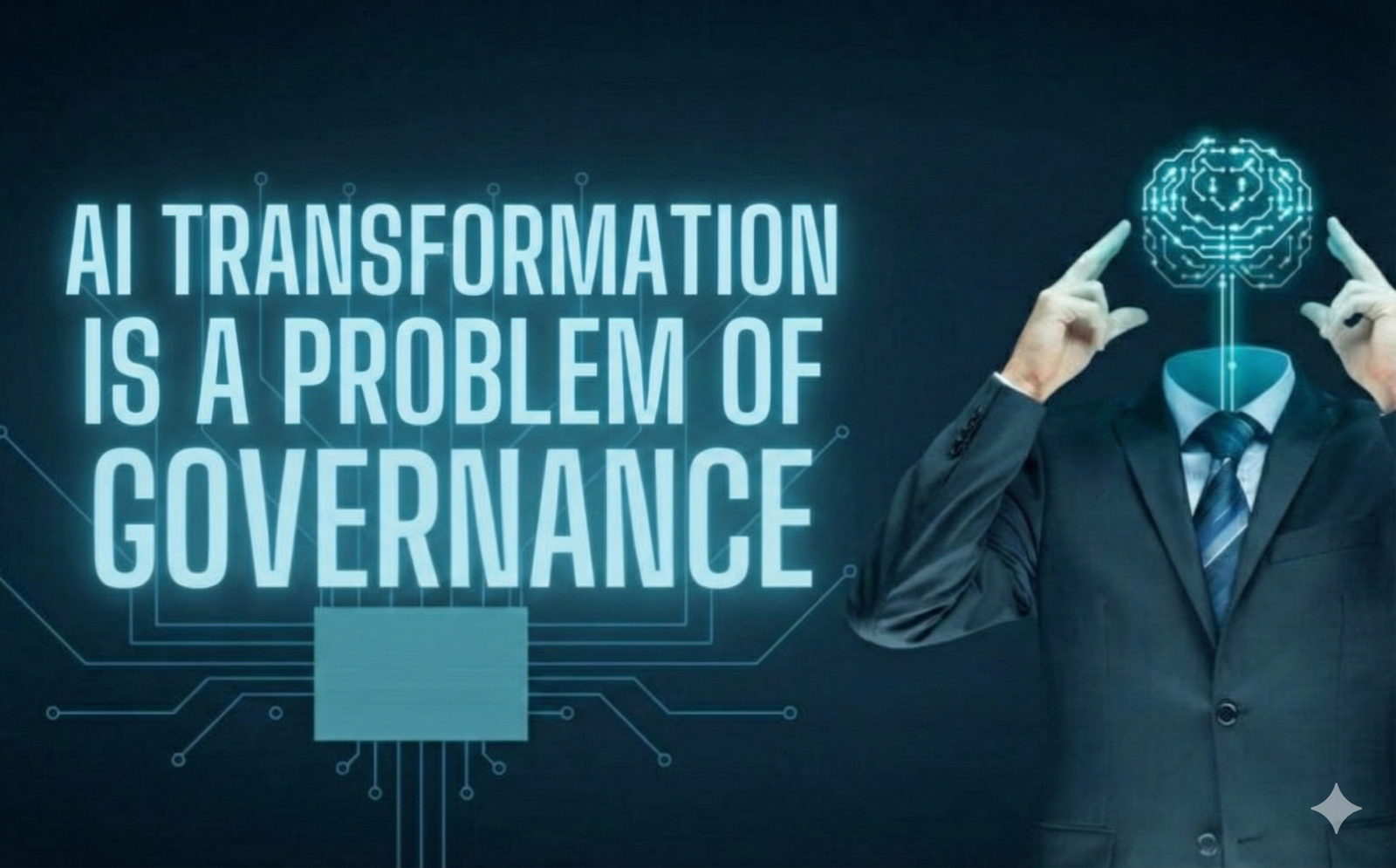
Let’s be real for a second. Everyone is talking about the flashy side of Artificial Intelligence—the new chatbots, the generated videos, and the tools that can write code in seconds. It’s exciting, right? But if you peel back the layers, you realize that the real challenge isn’t just about the technology itself. It’s about how we manage it. At its heart, successful ai transformation is a problem of governance.
If we don’t have the right rules, guardrails, and oversight in place, even the smartest tech can create chaos. We are seeing this happen right now in 2026. Companies are racing to adopt AI, but they are tripping over legal hurdles, ethical issues, and compliance nightmares.
In this article, we are going to dive deep into why governance is the missing piece of the puzzle, what’s happening with regulations like the EU AI Act right now, and how organizations can actually fix this mess.
Why Governance is the Real Bottleneck
Imagine buying a Ferrari but having no steering wheel and no brakes. That is basically what deploying enterprise AI without governance feels like. You have speed, sure, but you have zero control over where you are going.
For a long time, businesses treated AI governance as a boring checklist. It was something the legal team worried about while the engineers built cool stuff. But that approach is dead. Today, if you can’t trust your AI, you can’t use it.
The issue is that technology moves fast—way faster than laws do. By the time a government passes a regulation, the tech has already evolved three times. This creates a massive gap where accountability gets lost. Who is to blame when an AI makes a biased hiring decision? The developer? The user? The data scientist? Without clear governance, nobody knows.
The “Black Box” Problem
One of the biggest headaches is that many modern AI models are “black boxes.” This means even the creators don’t fully understand how the AI arrived at a specific answer. From a governance perspective, this is a nightmare. How can you regulate something you can’t explain? This opacity makes it incredibly hard to trust the output, especially in high-stakes fields like healthcare or finance.
Key Challenges We Are Facing Right Now
Governance isn’t just one big problem; it’s a collection of many tricky issues. Let’s break down the main hurdles organizations are facing in 2026.
1. Political and Economic Pressures
Big Tech companies are under immense pressure to dominate the market. This approach favors quick progress, even when it risks unintended consequences. They want to push products out the door to keep stock prices high, often at the expense of safety checks. This creates a conflict between making money and being responsible.
2. Balancing Innovation with Risk
This is the classic tightrope walk. If your rules are too strict, you stifle innovation and your company falls behind. If your rules are too loose, you risk data leaks, bad publicity, or massive fines. Finding the “Goldilocks zone”—where you have enough freedom to innovate but enough control to stay safe—is the hardest part of ai transformation.
3. Data Quality and Autonomy
AI is only as good as the data it learns from. Poor or biased data leads directly to poor and biased AI outcomes. Plus, as we move toward “Agentic AI” (AI that can take actions on its own without human approval), the risks skyrocket. Governance needs to evolve from “checking the data” to “monitoring the agent’s behavior.”
| Risk Category | Description | Governance Solution |
| Bias & Fairness | AI favoring one group over another. | Regular audits and diverse training data. |
| Privacy | Leaking sensitive user info. | Strict access controls and data masking. |
| Hallucination | AI making up false facts confidently. | Human-in-the-loop verification processes. |
| Compliance | Breaking laws like GDPR or the EU AI Act. | Automated compliance tracking tools. |
The EU AI Act: 2026 Enforcement is Here
We have been talking about it for years, but now it is real. The EU AI Act is fully enforceable as of this year, and it has teeth.
This isn’t just a suggestion list; it is a law with fines that can rival the GDPR. If you thought data privacy fines were huge, wait until you see the penalties for non-compliant AI. The Act specifically targets “high-risk” systems. These are AI tools used in critical areas like education, employment, and law enforcement.
You May Also Read: Tech Giants Envision Future Beyond Smartphones
What Companies Must Do Now
If you are operating in or selling to the EU, you need to have a few things ready immediately:
- AI Inventories: You need a complete list of every AI system you are running. You can’t govern what you don’t know you have.
- Risk Assessments: You must document the potential harms your AI could cause.
- Human Oversight: You cannot just let the machine run wild. A human must be able to step in and stop the system if things go wrong.
Table 2: The Reality of Compliance vs. Operations
| Regulation Requirement | Operational Reality | The Gap |
| Explainability | Models are complex and opaque. | Hard to explain “why” an AI did X. |
| Data Governance | Data is siloed and messy. | Cleaning data takes 80% of the time. |
| Human Oversight | Humans get tired or trust AI too much. | “Automation Bias” makes oversight weak. |
Global Coordination: A World Divided
While Europe is laying down the law, the rest of the world is a bit of a mixed bag. This lack of global coordination makes things really difficult for international companies.
The Gulf Region’s Uncertainty
Regions like the Gulf are investing billions into AI, but their regulatory frameworks are still catching up. They are facing unique challenges in regulating unpredictable AI behaviors. They want to be leaders in tech, but they are also wary of the risks. This creates a confusing environment for businesses trying to set up shop there. Do you follow EU rules? US rules? Or local guidelines that are still being written?
The “Splinternet” of AI Rules
We are seeing a fragmentation of standards. China has its own strict rules on content. The US prefers a more sector-specific approach (rules for healthcare AI, rules for finance AI, etc.). The EU goes for a broad, blanket law.
This means a global company might need three or four different governance strategies depending on where they are operating. It is inefficient and costly, but right now, it is the reality.
Operational Hurdles: Why is this so Hard?
Okay, so we know we need governance. Why aren’t companies just doing it? Because it is incredibly hard to implement on the ground.
Legacy Systems
Most big companies are running on technology that is 20 years old. Trying to bolt modern AI onto a dusty old database is like putting a jet engine on a bicycle. It doesn’t work well, and it makes governance nearly impossible because the old systems weren’t built for transparency.
The Skill Gap
Who is supposed to run these governance programs? Lawyers don’t understand the code. Engineers don’t understand the law. There is a massive shortage of people who speak both languages. We need “AI Ethicists” and “Governance Officers,” but there just aren’t enough of them yet.
Governance as Friction
This is a cultural problem. In many organizations, the governance team is seen as the “Department of No.” They are viewed as friction—something that slows down the real work. Until companies realize that governance is actually a “guardrail” that allows them to drive faster safely, this tension will remain.
Real-Time Developments (January 2026)
Since we are in January 2026, let’s look at what is happening right now in the news. The landscape is shifting almost daily.
The EU “Omnibus” Clarification
There is a lot of confusion about the specific details of the AI Act. Rumor has it that the EU is eyeing an “omnibus” update to clarify some of the vaguer definitions. Businesses are pushing for this because they are currently paralyzed by uncertainty. They don’t want to get fined, so they are pausing innovation until they know exactly where the line is drawn.
UK Taps Experts for Public Services
The UK is taking a different approach. They are bringing in top-tier AI experts to help integrate AI into public services like transport and security. Instead of just regulating from the outside, the government is trying to build expertise from the inside. This is a smart move that could serve as a model for other nations.
The Rise of ISO/IEC 42001
You might start seeing this number a lot: ISO/IEC 42001. This is the new global standard for AI management systems. Organizations are scrambling to get certified.
It emphasizes “ethics-by-design.” This means you don’t just build an AI and then check if it’s ethical later. You build the ethics into the code from day one. Cross-functional committees—groups made up of tech, legal, HR, and business leaders—are becoming a requirement to get this certification.
My Opinion: The Path Forward
If you ask me, ai transformation is a problem of governance more than it is a problem of technology. We have the tech. The code works. But the system around the code is broken.
Success in this new era hinges on proactive, operational frameworks. We cannot rely on post-hoc compliance checklists (checking boxes after the product is built). That is a recipe for disaster. Accountability must be embedded from the design phase.
Without this shift, the productivity gains everyone is excited about will be wiped out by the harms. Imagine an AI that doubles your coding speed but introduces a security vulnerability in every tenth line. Is that a net gain? No.
The cases we are seeing in the EU and the Gulf show the urgency for adaptive, international standards. We need to foster trust. If people don’t trust AI, they won’t use it, and the transformation will fail. We need to scale responsibly, or we shouldn’t scale at all.
Conclusion
AI is changing the world, but it is a wild beast that needs taming. The organizations that win in the next decade won’t just be the ones with the best algorithms. They will be the ones with the best governance.
By treating governance as a strategic advantage rather than a compliance burden, companies can build trust, avoid fines, and create AI that actually helps people. It is time to stop looking at AI as just a tech project and start treating it as a governance challenge.
Frequently Asked Questions (FAQs)
1. What does “AI transformation is a problem of governance” mean?
It means that the main barrier to successfully using AI isn’t the technology itself, but the lack of rules, oversight, and management strategies to use it safely and legally.
2. What is the EU AI Act doing in 2026?
As of 2026, the EU AI Act is enforcing strict rules on “high-risk” AI systems. It requires companies to keep inventories of their AI, assess risks, and ensure human oversight, with massive fines for non-compliance.
3. What is ISO/IEC 42001?
It is a global standard for AI management systems. It helps organizations ensure they are developing and using AI responsibly, focusing on ethics and continuous monitoring.
4. Why is the “Black Box” problem an issue for governance?
If you can’t explain how an AI reached a decision (because it’s a “black box”), you can’t easily audit it for fairness or accuracy. This makes it hard to comply with laws that require transparency.
5. How does poor data affect AI governance?
AI learns from data. If the data is bad (biased, incomplete, or inaccurate), the AI’s decisions will be bad. Governance must focus heavily on ensuring data quality before it ever reaches the AI model.