

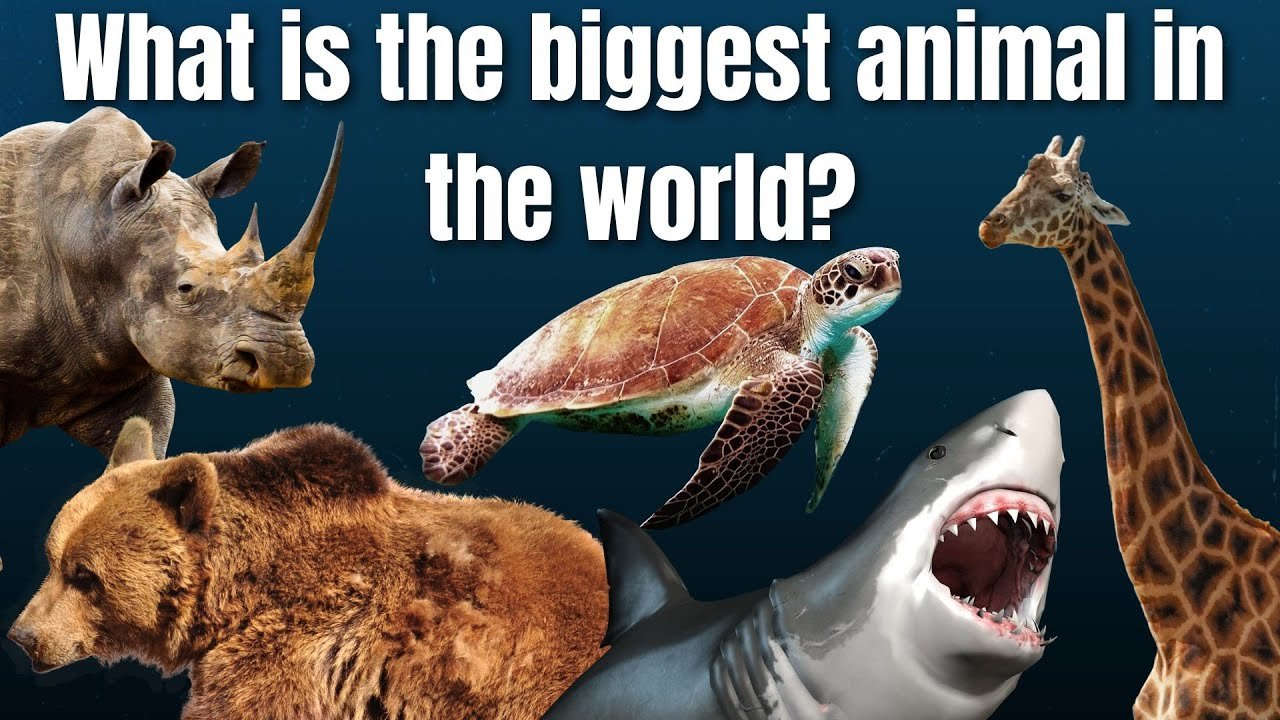
Have you ever looked up at a skyscraper and wondered what it would feel like if an animal that big actually existed? It’s a question that has fascinated scientists, kids, and nature lovers for centuries. When we think about giants, our minds often drift to the dinosaurs. We picture the T-Rex or the long-necked sauropods stomping around the prehistoric jungle. But here is a surprising fact that might shock you: the true champion of size isn’t a dinosaur at all.
If you are asking yourself, what was the biggest animal in the world, the answer is swimming in our oceans right now. It is the Blue Whale. Even with all the fossil discoveries and the giant beasts of the past, the modern Blue Whale holds the title for the heaviest animal to ever exist in the history of Earth.
In this article, we are going to dive deep (pun intended!) into the fascinating world of these giants. We will look at the massive Blue Whale, compare it to the ancient dinosaurs that shook the ground, and investigate some controversial fossils that recently challenged the whale’s title.
The Reigning Champion: The Blue Whale
Let’s get straight to the point. When we talk about pure mass and weight, the Blue Whale is absolutely unmatched. It is hard to wrap your head around just how big these creatures are without seeing them.
Mind-Blowing Stats of the Blue Whale
A typical Blue Whale measures between 25 to 30 meters (82 to 98 feet) in length. To put that in perspective, that is roughly the length of three school buses lined up bumper to bumper. But length isn’t the only thing that matters here; it’s the weight that really sets them apart.
These marine mammals weigh between 100 and 200 metric tons. The heaviest recorded Blue Whale was estimated to be around 190 tons, and scientific models suggest they could even reach up to 250+ tons if they live long enough and have plenty of food.
Let’s break that down into things we can understand:
- Their tongue alone weighs as much as an entire elephant.
- Their heart is the size of a bumper car (or a small Volkswagen Beetle).
- A human child could crawl through their major blood vessels.
Because they live in the ocean, Blue Whales don’t have to support all that weight on legs. The water does the heavy lifting for them. This allows them to grow to sizes that would be physically impossible on land. If a Blue Whale were placed on a beach, its own weight would crush its internal organs. That is why the answer to what was the biggest animal in the world will almost always be an aquatic animal.
Blue Whale vs. Perucetus Colossus: The Heavyweight Title Fight
Recently, there was a lot of buzz in the news about a prehistoric whale called Perucetus colossus. This fossil was found in Peru and dates back to the Paleogene period (roughly 39 million years ago). Initially, some scientists thought this thick-boned ancient whale might have weighed up to 340 tons, which would have crushed the Blue Whale’s record.
However, science is always correcting itself. Recent studies have taken a closer look at the Perucetus colossus. While it was definitely heavy, the newer estimates put it closer to 85 to 180 tons on average.
The Perucetus was shorter than a Blue Whale, measuring about 17 to 21 meters, but it was incredibly dense. It had super-heavy bones to help it stay underwater while grazing. But even with that density, the consensus among experts today is that the Blue Whale is still the king. The extreme upper estimates for Perucetus have been revised downward, meaning the Blue Whale retains its crown as the heaviest animal of all time.
The Giants of the Land: Sauropod Dinosaurs
Okay, so the ocean belongs to the whale. But what about dry land? If you were walking around during the Cretaceous period, you would have encountered animals that make modern elephants look like toys. These were the Sauropods—the long-necked, long-tailed dinosaurs.
Argentinosaurus: The Earth Shaker
If we look at terrestrial (land-living) animals, the title for the heaviest likely goes to Argentinosaurus. Living in the Late Cretaceous period in what is now South America, this beast was truly a titan.
Estimates for Argentinosaurus suggest it was about 35 to 40 meters long. That is actually longer than a Blue Whale! However, length doesn’t equal weight. Because dinosaurs had hollow bones (similar to birds) and air sacs to help them breathe and move, they were much lighter for their size than a whale.
Argentinosaurus is estimated to have weighed between 70 and 110 tons. While that is incredibly heavy—imagine 15 African elephants standing on top of each other—it is still only about half the weight of a large Blue Whale.
Patagotitan: The Museum Star
Another famous contender is Patagotitan. You might have seen a cast of this dinosaur’s skeleton in museums. It lived during the Mid-Cretaceous and was also massive, reaching roughly 37 meters in length.
Its weight is estimated at around 70 to 75 tons. These animals had to defy gravity. They relied on pillar-like legs, almost like tree trunks, to hold them up. It is an engineering marvel that biology could create a land animal this big. But again, gravity has its limits. If they got much heavier, their bones might have snapped under the strain.
A Quick Comparison of the Titans
Here is a quick look at how these giants stack up against each other.
| Animal | Length (meters) | Weight (metric tons) | Habitat | Era |
| Blue Whale | 25-33 | 100-273 | Ocean | Modern |
| Argentinosaurus | ~35-40 | ~100-110 | Land | Late Cretaceous |
| Patagotitan | ~37 | ~70-75 | Land | Mid-Cretaceous |
| Perucetus colossus | ~17-21 | 85-180 (est.) | Ocean | Paleogene |
The Largest Land Mammal: Paraceratherium
We have talked about whales and dinosaurs, but what about mammals on land? After the dinosaurs went extinct, mammals took over. The biggest mammal to ever walk on land was the Paraceratherium.
Imagine a rhinoceros, but stretch it out until it looks like a giraffe. That is roughly what Paraceratherium looked like. It lived during the Oligocene epoch. It stood about 5.5 meters (18 feet) tall at the shoulder and had a long neck for eating leaves off tall trees.
Despite being the biggest land mammal, it was small compared to the dinosaurs. It weighed up to 22 tons. This shows that mammals on land generally haven’t been able to reach the same gargantuan sizes as the reptiles of the past, likely due to differences in bone structure and metabolism.
Why Size Matters: Land vs. Sea
You might be wondering why the ocean allows animals to get so much bigger. The answer is simple physics.
When an animal lives on land, it fights gravity every second of the day. Every step requires muscle and bone strength to keep the body from collapsing. There is a limit to how strong bone can get. If a land animal became as heavy as a Blue Whale, its legs would need to be so wide to support it that it wouldn’t be able to walk!
In the ocean, the water provides buoyancy. The water supports the animal’s mass. This means a whale doesn’t need legs. It can pack on blubber and muscle without worrying about gravity crushing it. This is the main reason why, when you ask what was the biggest animal in the world, the answer comes from the deep blue sea.
Detailed Breakdown
To help you visualize the differences even better, we have broken down the specific categories of these giants below.
| Category | Record Holder | Weight Limit | Primary Advantage |
| Heaviest Ever | Blue Whale | 200+ Tons | Buoyancy (Water support) |
| Longest Land Animal | Argentinosaurus | ~110 Tons | Hollow bones/Air sacs |
| Largest Land Mammal | Paraceratherium | ~22 Tons | Height for browsing trees |
Honorable Mentions: Other Prehistoric Giants
We can’t finish this article without mentioning a few other massive creatures that once roamed (or swam) our planet.
Shastasaurus
Before the whales took over the oceans, marine reptiles ruled. The Shastasaurus was a massive Ichthyosaur that lived during the Triassic period. It grew up to 21 meters long. While it was long, it was much slenderer than a whale, weighing roughly 75 tons. It was impressive, but still not enough to knock the Blue Whale off the podium.
Megalodon
Everyone loves the Megalodon. This giant shark is a pop-culture icon. However, compared to a Blue Whale, the Megalodon was actually quite small! Estimates suggest it reached about 15-18 meters in length and weighed roughly 50-60 tons. A Blue Whale is nearly four times heavier than the biggest Megalodon was.
Conclusion
So, to settle the debate once and for all: what was the biggest animal in the world?
The undisputed champion is the Blue Whale.
While the dinosaurs like Argentinosaurus were longer and incredibly impressive, they couldn’t match the sheer mass and weight of the Blue Whale. The ocean environment allows the Blue Whale to grow to sizes that land physics just won’t allow. Even the controversial fossil Perucetus colossus, which gave the whale a run for its money in the headlines, has been scientifically resized to sit comfortably in second place.
It is truly amazing to think that we live in the same time period as the greatest giant in Earth’s history. We don’t need a time machine to see the biggest animal ever—we just need a boat!
Frequently Asked Questions (FAQs)
1. Is the Blue Whale bigger than the Megalodon?
Yes, absolutely. A Blue Whale is much larger than a Megalodon. The Blue Whale can weigh up to 200 tons, while the Megalodon maxed out around 60 tons.
2. Could there be a bigger animal we haven’t found yet?
It is possible, especially in the fossil record. We have only explored a tiny fraction of Earth’s history. However, biological laws (like how much oxygen an animal needs and how strong bones can be) suggest we are close to the limit of how big an animal can biologically get.
3. What is the biggest animal on land today?
Today, the African Bush Elephant is the largest land animal. But at roughly 6 to 7 tons, it is tiny compared to the prehistoric Argentinosaurus or the modern Blue Whale.